Minimal Outfits
Five Minimalist Outfit Formulas for the Working Week
Five repeatable outfit formulas built from a small wardrobe, with the small adjustments that keep each one from looking like a uniform.
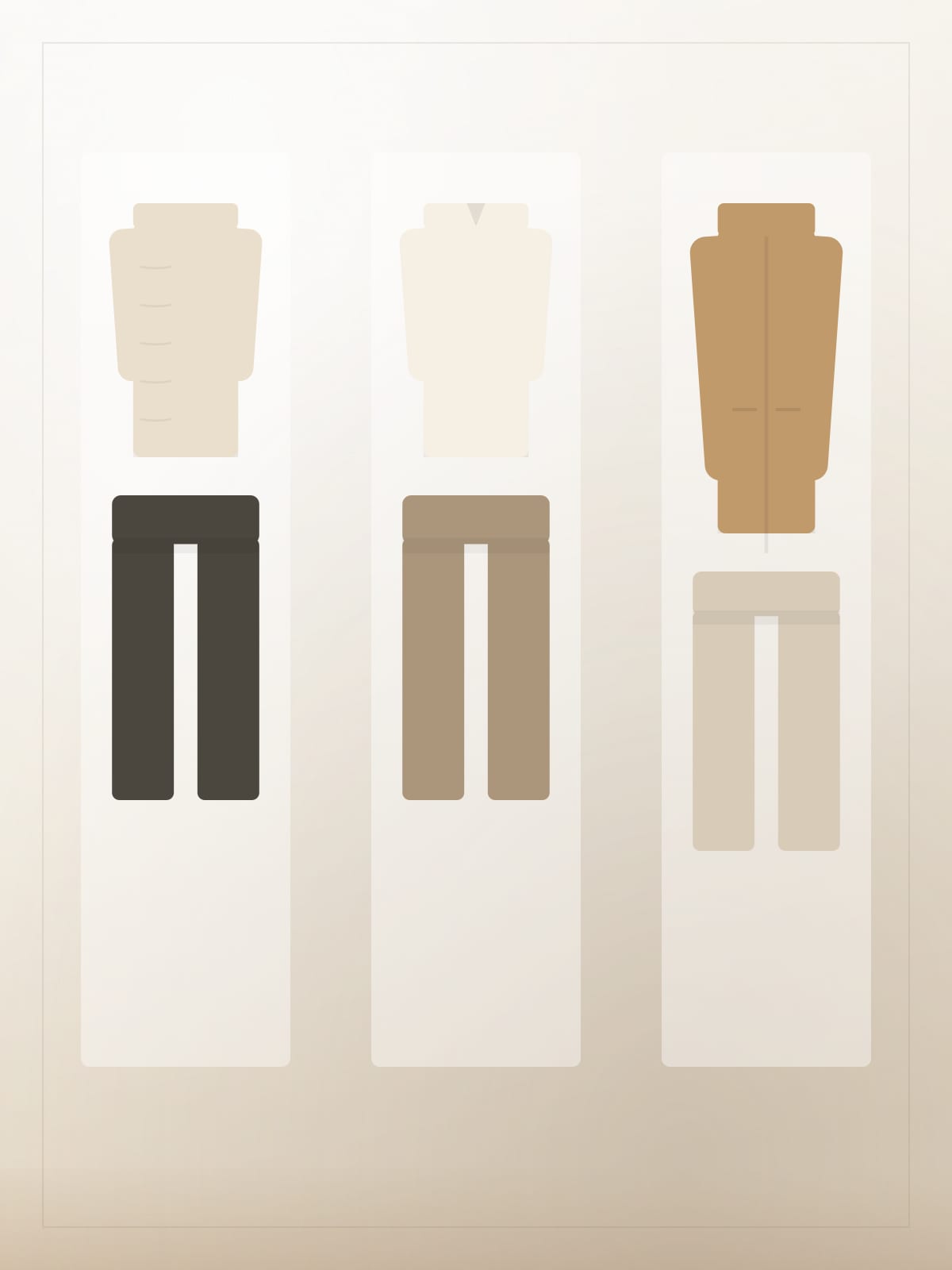
A formula is not an outfit. It is a sentence with blanks in it, which is why it survives contact with a real morning: you fill the blanks with whatever is clean.
These five cover a normal working week. Each one takes under a minute to assemble once the pieces are in your closet.
The formula pattern
Every formula below follows the same structure: a base, a layer, a shoe, and one deliberate detail. The base does the work. The layer handles temperature and formality. The shoe sets the register. The detail is what stops the whole thing from reading as a uniform.
If you get the base and the shoe right, the rest is optional.
1. Knit + tailored trouser + loafer
The most reliable outfit in a minimal wardrobe. A fine-gauge knit in oatmeal or charcoal, a straight wool trouser, a leather loafer.
The adjustment: the knit should hit at or just below the waistband. A long knit over a wide trouser adds visual weight exactly where you do not want it; a shorter one, or a half-tuck, restores proportion.
Works for: offices with a dress code, dinners that start straight after work.
2. Shirt + denim + ankle boot
A cotton poplin or oxford shirt, dark straight denim, a leather ankle boot. Roll the cuff once, not three times.
The adjustment: leave the shirt untucked but ironed, or tuck it fully and add a belt. Half-tucked shirts look accidental unless the fabric is soft enough to fall that way on purpose.
Works for: the days with a client lunch and no time to change.
3. T-shirt + blazer + relaxed trouser
The formula that made "smart casual" survivable. A heavyweight white tee, an unlined blazer, a cotton or linen-blend trouser, a sneaker or a flat.
The adjustment: the tee is the whole outfit. A thin, shiny or slightly grey white tee will drag the blazer down with it. Heavier cotton, a clean neckline and a fit that skims rather than clings.
Works for: creative offices, travel days, anything with the word "informal" in the invitation.
4. Dress + flat + structured bag
One piece, two accessories, done. A knit or jersey dress in a midi length, a flat, a bag with a shape.
The adjustment: the bag is doing the formality. A tote reads weekend; a structured bag reads meeting. Same dress, different week.
Works for: days when you cannot think, which is more days than most style advice admits.
5. Overshirt + knit + straight leg + boot
The cold-weather version of formula 1. A wool overshirt or shirt-jacket over a fine knit, straight trousers, a boot with some tread.
The adjustment: keep the two layers close in tone. A dark overshirt over a light knit creates a hard horizontal line at the hem; a mid-tone over a light knit keeps the vertical.
Works for: commutes that involve standing on a platform.
Making five formulas feel like a wardrobe
Five outfits worn in rotation will look like five outfits. Three things break the repetition without buying anything:
- Change the shoe. The same base with a loafer, a sneaker and a boot is three different registers.
- Change the outer layer. A trench, a wool coat and a quilted jacket reframe everything underneath.
- Change the detail. A belt, a scarf, a watch, a different bag. Small, cheap, effective.
What you should not do is add a sixth formula because the first five feel boring. Boredom with a working wardrobe is usually a sign that the clothes are fine and the week is long.
Build the formulas into the closet
If you are assembling a wardrobe from scratch, buy for these five outfits rather than for individual pieces. That means one good trouser, one good knit, one good shirt, one good tee, one dress, one blazer, one overshirt, one loafer, one boot, one sneaker.
Ten pieces. Fifteen outfits. That is the whole trick, and it is why the 30-piece checklist is organised the way it is.
For the colour logic that makes these combinations work without effort, see how to wear neutrals.
Read next
Guides that share this one’s wardrobe logic.

How to Wear Neutrals Without Looking Washed Out
Why an all-neutral wardrobe can make you look tired, and the three adjustments — contrast, temperature and texture — that fix it.
A Minimalist Work Wardrobe for a Business-Casual Office
What to wear to an office that means "smart casual" but expects polish — twelve pieces, four outfits and the rules that actually get enforced.

The 30-Piece Capsule Wardrobe Checklist
A printable 30-piece capsule wardrobe list for a four-season climate, with the swaps to make for hot summers, cold winters and a casual office.