Minimal Outfits
How to Wear Neutrals Without Looking Washed Out
Why an all-neutral wardrobe can make you look tired, and the three adjustments — contrast, temperature and texture — that fix it.

Neutrals are supposed to make dressing easier. Then you put on a cream knit, stone trousers and a beige coat, look in the mirror, and discover you have dressed as a lampshade.
The problem is almost never the palette. It is three specific things that go wrong when a wardrobe narrows to neutrals.
1. Everything is the same value
Value is how light or dark a colour is, ignoring its hue. Cream, oat, sand and stone sit within a narrow band of value: put them together and the eye finds no edge to hold on to. The result reads as one soft mass, which is why the outfit looks flat rather than calm.
The fix is one deliberate step in value — not a jump to black:
- Light base, mid layer, dark shoe. Cream knit, stone trouser, charcoal loafer.
- Dark base, light layer. Charcoal trouser, oatmeal knit, cream coat.
- One dark anchor. Any all-light outfit plus a single dark element — a belt, a boot, a bag — gains structure immediately.
You do not need contrast in every element. You need one place where the eye can stop.
2. The temperature is wrong for your skin
Neutrals are not neutral. Beige, camel, taupe and ivory all carry an undertone: some lean yellow and warm, some lean pink or grey and cool. Wearing a warm beige next to cool-toned skin can make both look sallow, and the effect is strongest in photographs.
A quick test, done once, in daylight:
- Hold a warm beige (think camel, wheat, honey) under your chin.
- Then hold a cool beige (think greige, mushroom, dove grey).
- Look at your jawline, not the fabric.
The one that makes the shadow under your jaw look softer is your side of the palette. It is not subtle once you see it, and it does not change with fashion.
If you genuinely cannot tell, buy the cool side. Cool neutrals are more forgiving in artificial light, which is where most of us spend the evening.
3. Every fabric has the same surface
A wardrobe of matte cotton and flat wool in four shades of beige is visually silent. Texture is what gives a neutral outfit something to say:
- Pair a smooth with a nubby. Fine-gauge knit with a brushed wool trouser.
- Pair a matte with a sheen. Cotton poplin shirt with a satin-back skirt, or a wool coat over a silk shell.
- Pair a stiff with a fluid. Structured blazer over a bias-cut dress.
Three textures in one outfit is plenty. Two is usually enough.
Build a palette you will not get bored of
If you are starting from scratch, a workable neutral palette has four slots:
| Slot | Examples | Job |
|---|---|---|
| Light base | cream, ivory, ecru | shirts, knits, tees |
| Mid neutral | oat, stone, greige | trousers, knitwear |
| Deep anchor | charcoal, navy, chocolate | outerwear, shoes, bags |
| Accent | camel, rust, olive | one or two pieces only |
The accent slot is the one people overfill. One camel coat and one rust knit will carry a wardrobe for years; five accent pieces will fight each other and win.
Three outfits that use the same four pieces
Take a cream knit, stone trousers, a charcoal coat and a camel loafer.
- Day: cream knit, stone trousers, camel loafer. Light and mid, warm shoe. Soft, works for a casual office.
- Evening: cream knit, stone trousers, charcoal coat, no visible shoe change. The dark coat does the work.
- Cold: add a charcoal knit under the coat, keep the cream at the collar. Two values, one texture shift.
Four pieces, three registers. Nothing was bought.
The one rule worth keeping
If an outfit looks tired, add contrast before you add colour. Almost every "I look washed out in neutrals" problem is a value problem, and value is free to fix — it is a matter of which pieces you put next to each other, not which pieces you own.
For the pieces themselves, see the 30-piece checklist, and for the outfits, the five formulas.
Read next
Guides that share this one’s wardrobe logic.
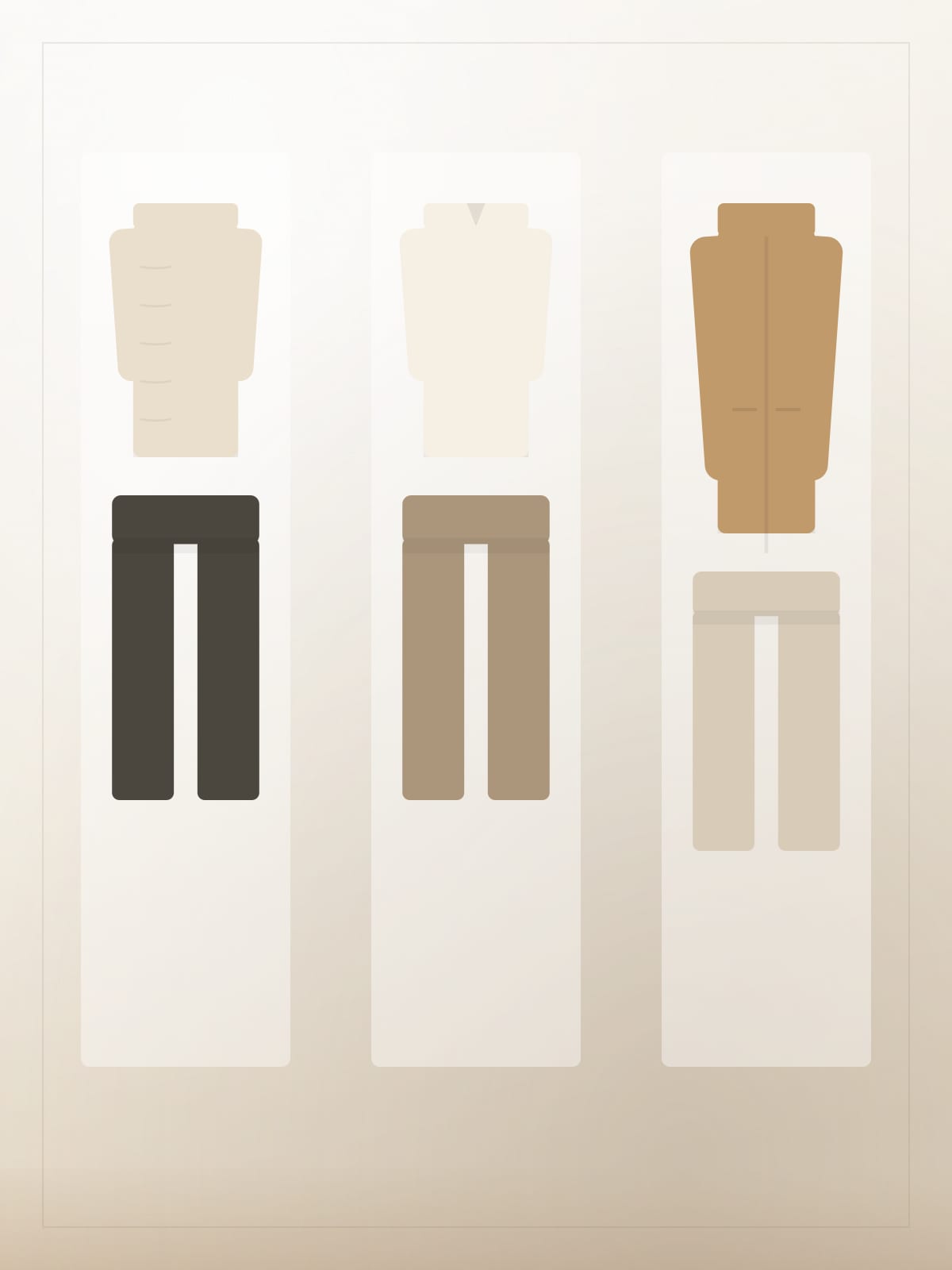
Five Minimalist Outfit Formulas for the Working Week
Five repeatable outfit formulas built from a small wardrobe, with the small adjustments that keep each one from looking like a uniform.
A Minimalist Work Wardrobe for a Business-Casual Office
What to wear to an office that means "smart casual" but expects polish — twelve pieces, four outfits and the rules that actually get enforced.
What to Pack for a Week Away With Carry-On Only
A carry-on packing list for a week of mixed weather, built from a small wardrobe, with the two outfits that do the travelling.