Essential Accessories
Layering Fine Jewelry: A Simple Guide
Chain lengths, metals and proportions — a practical method for layering necklaces and rings without tangling, clashing or overdoing it.
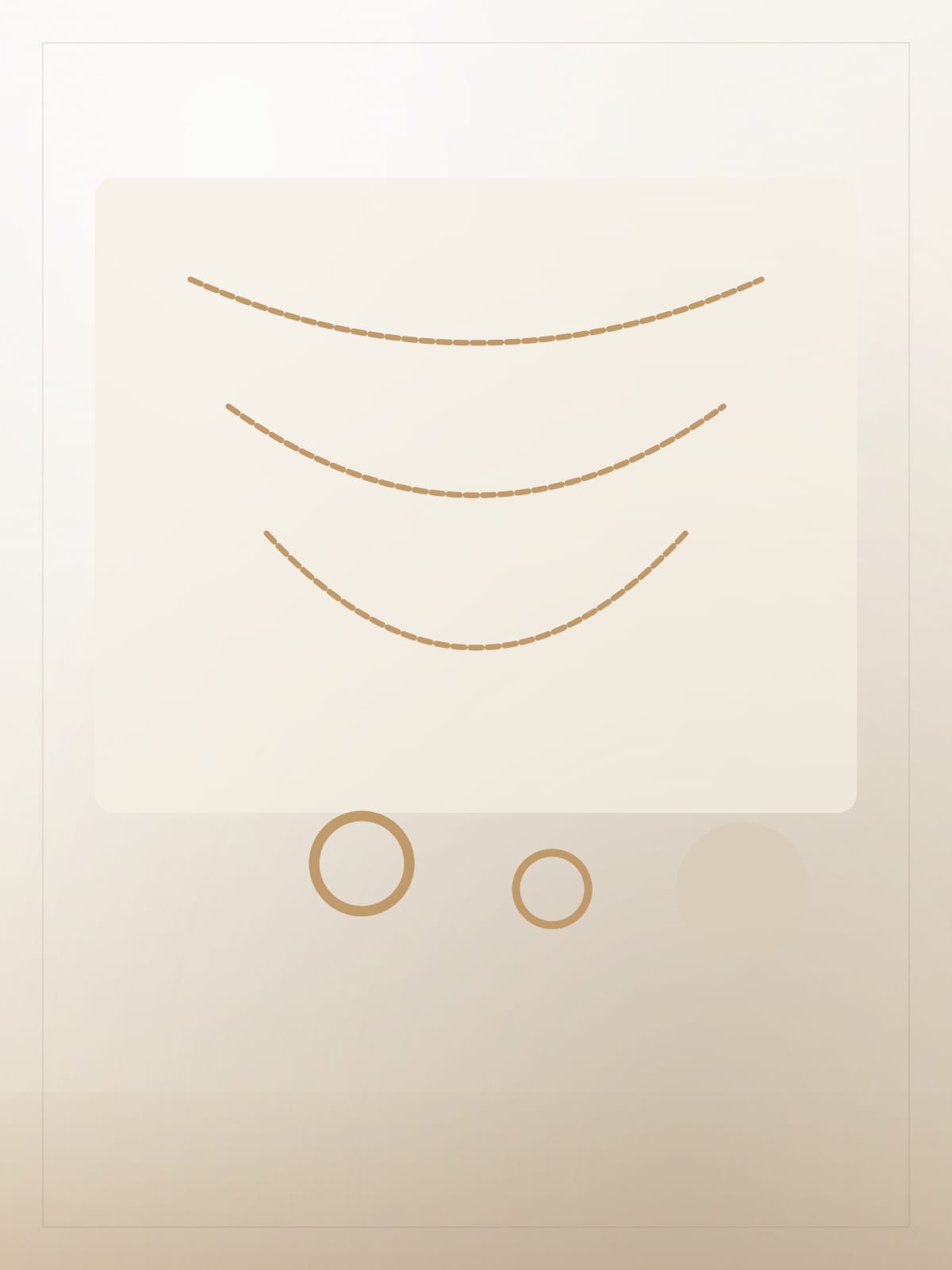
Layering jewelry looks effortless in photographs and turns into a knot in real life. The difference is almost entirely about length and weight — two things you can plan before you put anything on.
The length rule
Three necklaces need three different lengths, with at least 5cm between each. Closer than that and they collide at the collarbone and tangle within an hour.
A reliable set:
- 38 to 40cm — a choker or short chain that sits at the base of the throat
- 45 to 48cm — the standard pendant length, resting on the collarbone
- 55 to 60cm — a longer chain that falls below the collarbone
Two necklaces are easier and often better. If you layer two, put 8 to 10cm between them.
The weight rule
Layer one fine chain, one medium chain and one pendant. Three fine chains of the same gauge read as a single blurred line; three heavy chains read as armour.
The pendant is the anchor. Put it on the middle or longest chain, never the shortest — a pendant at the throat competes with your jaw rather than framing it.
Metals: mix deliberately
Mixing gold and silver is fine and has been for a decade. What looks accidental is mixing without a bridge.
Two ways to make it intentional:
- Two-tone pieces. A single piece with both metals ties the rest together.
- Repeat the minority metal. If you wear mostly gold with one silver chain, add silver hoops. The eye reads repetition as intention.
Keep it to two metals. Three is a decision that needs a stylist.
Rings and stacking
- Stack on one hand, not both. Two or three rings on one hand reads as a choice; rings on every finger reads as a collection.
- Vary the width. A thin band next to a wider one, and one plain band between two textured ones.
- Leave one finger bare. The negative space is what makes the stack look considered.
Earrings with layered necklaces
If the necklace is the focus, keep the earring small — a stud or a thin hoop. If the earring is the focus, wear one necklace or none.
The exception: a single statement earring with a bare neck. That combination has never looked wrong.
What to buy first
If you are starting a collection rather than organising one:
- A fine chain at 45cm that suits your skin tone.
- A second chain at 55cm, slightly heavier.
- A small pendant for one of them.
- A pair of hoops sized to your face — roughly the width of your jaw is a safe guide.
- A plain band for a ring finger.
Five pieces, worn in combinations, produce more than a dozen looks. That is the same arithmetic as a capsule wardrobe, applied to a smaller scale.
Care, briefly
- Put jewelry on last, after perfume and hairspray.
- Take it off first, before exercise and sleep.
- Store chains flat or hanging; a tangled chain weakens at the clasp.
- Polish with a soft cloth, not a silver dip, on anything plated.
For the rest of the accessory wardrobe, see the three bags worth owning and how to choose a timeless watch.
Read next
Guides that share this one’s wardrobe logic.

The Only Three Bags a Minimal Wardrobe Needs
A day bag, an evening bag and a travel bag cover almost every occasion — here is how to choose each one and what to ignore.
How to Choose a Timeless Watch Without Overpaying
Case size, movement, strap and dial — the four decisions that matter when buying a watch you intend to wear for twenty years.
How to Wear Neutrals Without Looking Washed Out
Why an all-neutral wardrobe can make you look tired, and the three adjustments — contrast, temperature and texture — that fix it.