Minimal Outfits
How to Build a Minimalist Wardrobe That Actually Works
A practical framework for a smaller wardrobe — how many pieces you really need, which ones earn their space, and how to stop buying the wrong things.
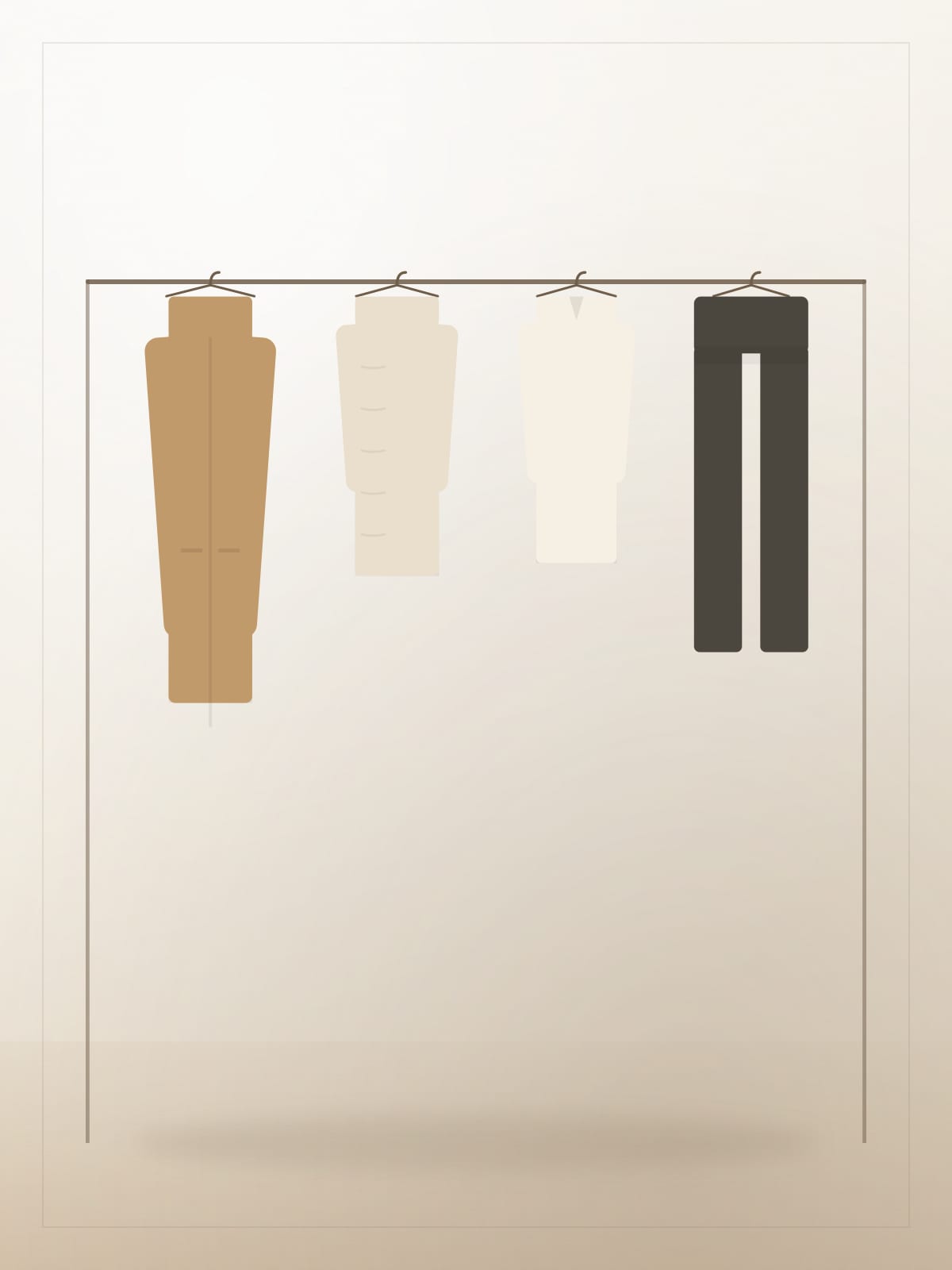
Most people do not own too few clothes. They own a lot of clothes and wear a small fraction of them. The goal of a minimalist wardrobe is not deprivation — it is a closet where the failure rate is close to zero, so getting dressed stops being a decision.
Here is the framework we use when we edit a wardrobe, whether it holds thirty pieces or ninety.
Start with what you actually wear
Before buying or discarding anything, track two weeks of outfits. Not what you would wear given a better wardrobe — what you wore, including the days you worked from home and the days you were late.
You are looking for three things:
- The repeat offenders. The pieces that show up four or five times in fourteen days.
- The one-and-done pieces. Worn once, usually for a specific event, usually uncomfortable.
- The gaps. The mornings you stood in front of a full closet and had nothing to put on.
The gaps are the only shopping list you need. Everything else is noise.
The number is smaller than you think
A workable wardrobe is usually 30 to 45 pieces, counting tops, bottoms, dresses, outerwear and shoes, and excluding underwear, sleepwear and gym clothes. If that sounds severe, notice that 35 pieces worn in combination produce several hundred outfits — far more than a season contains.
The number matters less than the ratio. A useful target is roughly:
- 8 to 10 tops that work alone and under layers
- 5 to 7 bottoms, at least two of them relaxed
- 3 to 5 dresses or one-piece outfits, if you wear them
- 4 to 6 pieces of outerwear, including one that handles rain
- 5 to 7 pairs of shoes, one of which is comfortable for a full day of walking
Nothing in that list is a rule. It is a shape. If you cycle to work in all weather, your outerwear count goes up and your heel count goes to zero. That is the system working.
Build in one palette, not one colour
The fastest way to make a small wardrobe feel repetitive is to buy everything in the same colour. The fastest way to make it feel chaotic is to buy everything you like.
Pick a palette of two neutrals, one deep tone and one warm or cool accent, then buy within it for a year. Oatmeal, charcoal, navy and a soft camel will combine in almost any order. A wardrobe built this way needs no styling skill — the pieces already agree with each other.
If you want a more detailed method, our neutral colour guide walks through building a palette you will not get bored of.
Judge fabric before design
A minimalist wardrobe only works if the pieces survive. Fewer, better things is not an aesthetic preference; it is the arithmetic that makes a small closet viable. A shirt you replace every eight months is not cheaper than one you replace every four years, and it is definitely not simpler.
Three quick checks in the fitting room:
- Hold it to the light. If you can see your hand clearly through a knit or a white shirt, it will pill, sag or show every seam within a season.
- Scrunch it and let go. Good cotton and wool recover. Cheap blends stay creased, which means you will iron it twice and then stop wearing it.
- Look at the seams. A straight, dense stitch line with a clean allowance is the cheapest quality signal available to you.
We go deeper on this in how to judge garment quality, including what a garment's weight actually tells you.
Let the wardrobe fail in public
The useful test of a minimalist wardrobe is not how it looks folded. It is whether it survives a bad morning: a meeting moved earlier, a delayed train, a spill at lunch.
Keep a note on your phone for one month. Every time an outfit disappoints you, write one line about why — "the trousers crease when I sit", "this top needs a specific bra", "these shoes are fine for two hours, not six". Those notes are worth more than any style guide, including this one, because they are about your actual life.
What to do with the rest
Pieces that fail the test are not automatically rubbish. Sort them into three piles:
- Alterable. A hem, a waist, a sleeve. Tailoring is usually cheaper than replacing and it converts almost-worn into worn.
- Resellable. Anything with life left and a recognisable label.
- Donatable. Everything else, clean and folded.
The point of the exercise is not virtue. It is that a closet containing only clothes you wear is a closet you can see.
A realistic timeline
Do not attempt this in a weekend. A wardrobe that works usually takes two or three months of small decisions:
- Week one: track outfits, no shopping.
- Week two: write the gap list, set a budget for the season.
- Weeks three to eight: buy only against the gap list, one piece at a time, and wear each new piece three times before buying the next.
- Week nine: review the notes, remove what still fails.
If you want the pieces themselves rather than the method, start with the 30-piece checklist and cut it down to your climate and your week.
The wardrobe is not the achievement. The quiet morning is.
Read next
Guides that share this one’s wardrobe logic.

The 30-Piece Capsule Wardrobe Checklist
A printable 30-piece capsule wardrobe list for a four-season climate, with the swaps to make for hot summers, cold winters and a casual office.
Five Minimalist Outfit Formulas for the Working Week
Five repeatable outfit formulas built from a small wardrobe, with the small adjustments that keep each one from looking like a uniform.

How to Wear Neutrals Without Looking Washed Out
Why an all-neutral wardrobe can make you look tired, and the three adjustments — contrast, temperature and texture — that fix it.